Mikes Camera Sigma 30mm F14 Dc Hsm Art Lens for Nikon
Dwelling house NewSearch Gallery How-To Books Links Workshops Near Contact
Sigma 30mm f/1.4
© 2007 KenRockwell.com

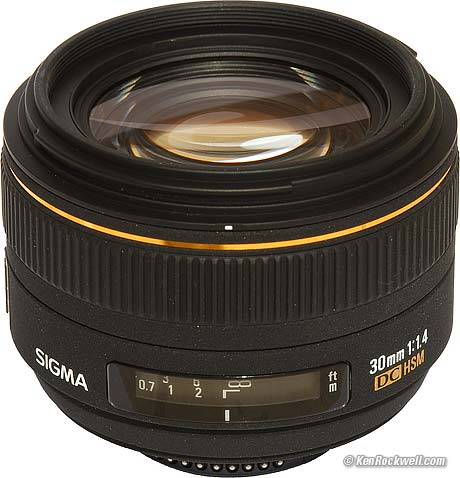
Sigma 30mm f/1.4.
I got this one hither. Y'all also can get it here. It helps me keep adding to this site when you get yours from those links, too.
June 2007 More Nikon Lens Tests More Canon Lens Tests.
INTRODUCTION
Top Specs Operation Recommendations
The Sigma 30mm f/one.four is a special-purpose, fast, stock-still normal focal length lens for small-format digital SLRs. It sells for near $420.
This Sigma lens works well when used as intended for hand-held shots in dim calorie-free. It's lightweight and works fast and easy, especially with the Nikon D40 and D40x, except that information technology doesn't focus very well or accurately.
If you shoot Canon, forget this Sigma and go the superior Catechism 28mm f/1.8 EF for less money.
If you lot shoot Nikon, forget this dumpily-made Sigma and become the newest Nikon 35mm f/ane.eight for one-half the price.
Yous may consider the remainder of this review as an historical artifact from the good former first days of digital SLRs.
If y'all need a full f/1.4 in a normal focal length for a small-format digital camera, tin can piece of work around some repeatable autofocus inaccuracy and want to spend about $400, this is your lens.
Information technology comes in versions to fit Canon, Nikon, 4/3 system (Olympus, Panasonic), Pentax KAF, Samsung, Minolta A AF, Sony A and Sigma cameras. I tried the version for Nikon. I presume the others are optically identical.
This Sigma 30mm f/1.four lens gives the same angle of view, and somewhat greater depth-of-field at the aforementioned aperture, as a 50mm lens does on a picture show camera.
No other maker makes anything identical to a 30mm f/i.4 for under $1,000. If you need f/1.4 in a lens of this focal range for under a thousand dollars, this is it.
If you have a Nikon D40 or D40x, this too is your lens because Nikon makes no lenses faster than f/two.8 which autofocus with a D40/x.
If you're non using a D40 or D40x, if f/1.8 or f/ii is fast enough in this focal length, or if 50mm (80mm equivalent) is OK, you tin pay less and get genuine Canon or Nikon lenses instead. I'll embrace this subsequently at recommendations.
The Sigma 30mm f/1.four is not a wide-angle and information technology doesn't work on film, FX or full-frame cameras. I tried information technology, and the corners go black on total-frame. It easily covers 1.6x format Canon and Nikons. Information technology might even encompass 1.3x Canons like the 1D series, but I didn't attempt it. It'southward not rated to work with 1.3x cameras, and then skilful luck.
Good News:
1.) A unique lens that works and handles well. Information technology doesn't get in the mode.
2.) Lightweight.
3.) Fast and easy AF, especially with Nikon D40 and D40x.
iv.) But take hold of the focus ring, fifty-fifty in AF mode, for instant manual focus override with no demand to move whatever switches.
Bad News:
ane.) Blueprint flaw causes the manual focus confirmation light in my Nikons non to piece of work properly during manual focus override. Furthermore, another defect causes my cameras to ignore my manual focus override in AF-C mode and revert to autofocus. These can be worked around past manually setting my Nikons to manual focus, which eliminates some of the usefulness of instant manual focus override.
ii.) AF oft focused slightly in front of my subject with my D200, potentially significant at the large apertures for which y'all purchase this lens. I worked around this by pointing my AF sensors at something behind my subject if it was disquisitional. This isn't a trouble for existent, live 3D subjects. This consequence varies from sample to sample and camera to camera. It was fine on my D40.
three.). AF didn't focus beyond near 50' (20m) on my D200. I worked around this by setting focus manually using the authentic infinity marker on the focus calibration. It was fine on my D40.
iv.) Miscalibrated diaphragm lead to overexposed images. I worked around this past setting exposure compensation to -0.7 more than than what I would use with other lenses.
5.) Unmarried purpose: It doesn't zoom, and doesn't focus very close.
six.) Dinky-feeling plastic and rough transmission focus feel.
vii.) No infinity cease for astronomical use, but infinity marker was accurate.
eight.) Optics not up to astronomical use, and not equally sharp at smaller apertures as other slower lenses.
SPECIFICATIONS with commentary
Top Introduction Performance Recommendations
Name: Sigma calls this the 30mm F1.four EX DC HSM.
EX: "EXpensive." More expensive than other Sigma lenses.
HSM: "Hyper-Sonic Motor:" Quiet focusing and instant transmission focus override. Aforementioned thought as Nikon AF-southward SWM and Catechism EF USM.
DC: "Digitally Crippled." Only works on ane.6x Canon or Nikon digital cameras, not moving picture or 1.3x or full-frame digital. It also comes in mounts for Olympus iv/three and Sigma cameras.
Focal Length: 30mm. Used on a Nikon digital camera it gives an angle of view like to what a 46mm lens would give on a 35mm flick camera. On a Catechism one.6x camera it gives an angle of view similar to what a 49mm lens would give on a 35mm pic camera. Run into also Ingather Factor.
Maximum Aperture: f/1.four
Optics: vii elements, 7 groups, including one SLD and ane ELD glass element (same idea as Nikon's ED or Canon's UD) and 1 molded glass aspherical element. This magic drinking glass is supposed to help reduce colour fringing, while the aspherical element ought to help reduce coma and spherical abnormality at f/1.4. In practice this Sigma has more than color fringing and is fuzzier in the corners than my Nikon eighteen-200mm zoom, oh well.
Diaphragm: 8 blade octagonal, stopping downwards to f/16.
Filter Size: 62 mm.
Close Focus: 1.25' or 0.40 thou from the prototype plane (the back of the camera), rated. This isn't very close. All the like Catechism and Nikon lenses focus much closer. I encounter no mention of close-range correction or floating elements, which is most likely why it only focuses as close as a foot and a half.
Maximum Reproduction Ratio: 1:10.4, non very close.
Infrared Focus Index? No, unfortunately.
Size: 3.0" bore ten ii.three" extension from flange (76.6 10 59mm), rated.
Weight: 14.345oz. (406.7 g), measured, naked.
Hood: included.
Case: squeamish padded Cordura-style case included.
PERFORMANCE
Top Introduction Specs Recommendations
Autofocus Bokeh Color Color Fringes Construction
Baloney Ergonomics Exposure Falloff Flick Filters
Flare Macro Serial Number Sharpness Sunstars
OVERALL
Information technology works well for its intended purpose: low-light paw-held shooting. Optically information technology's not as good for shooting test charts every bit the Canon or Nikon f/1.4 lenses that toll several times every bit much, just this is irrelevant because of the tiny depth of field at f/1.4 for photographing real things.
FOCUSING back to Performance or back to Introduction.
Focusing works bang-up, one of the advantages of the Sigma 30mm f/i.4. Different my Nikon 28mm f/1.4, only take hold of the focus ring at any fourth dimension for transmission focus, no switches required. Unlike the Sigma 10-22mm which didn't always focus well with other than the fundamental AF sensor of my D200, this 30mm f/1.4 focuses fine with all my AF sensors.
Autofocus Accuracy
AF accurateness is fine for the things I would shoot with this lens, similar people and kids in dim light.
The Sigma 30mm f/1.4 is very bad, depending on your camera, for photographing at long distances. The AF system, at least on my D200 at f/i.4 and large apertures, consistently wouldn't focus at infinity and instead focused too closely. I focused by calibration instead for objects further away than about fifty feet (20m). If this is a lot of what you do, you lot probably won't be happy with this lens. It was perfect with my D40. This will vary from sample to sample and camera to camera.
AF accuracy is always a trouble for shooting exam charts with f/1.4 lenses. This has driven me crazy since the 1970s. For hand-held shots in dim light of wiggly subjects (the whole point of this lens) the AF accuracy is fine. For shooting flat test charts it's poor, but no one buys this lens for shooting test charts. For test charts and astronomical use, get the discontinued Nikon 28mm f/i.4 AF or the insanely practiced new Canon 85mm f/one.2L II.
At f/1.iv this is obvious if you're dumb plenty to be shooting at f/one.4 in daylight. In existent use it'south invisible at f/four, and in the dark information technology's not much of an issue since most things worth shooting are deeper than the depth of field anyhow. If you worry most these problems, don't get this lens, or at least try a different sample.

Ryan on his changing table. (D40, Sigma 30mm, f/ane.4 at i/30, Auto ISO chose ISO 1,600, cropped to near 50% of the paradigm.)
This shot is typical: focus is fine for the real things where one needs f/1.iv in dim low-cal. Find how his hand is completely out of focus due to no depth of field. This sort of shot is why you get this lens, and for this stuff, this lens is great. In the full size paradigm (non shown) his face, optics and texture of the fabric in his shirt await not bad. Remember, this kid never holds withal, so you can't focus manually on him or use a slower lens in the low-cal I had.
Here are more practical examples. In each case, focus is fine.

Palm Tree. (D200, Sigma 30mm, f/1.4 at 1/viii hand-held, Auto ISO chose ISO 1,600, full image.)
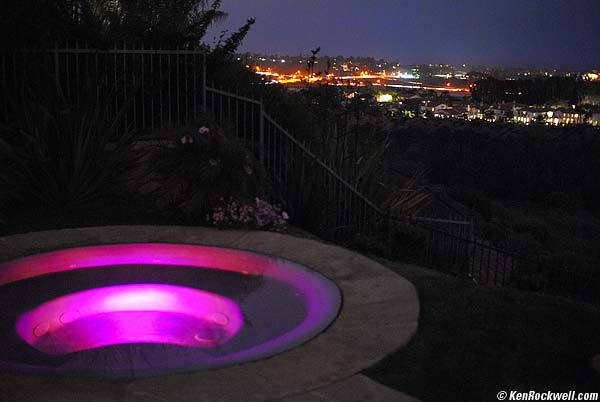
Spa on the Moon. (D200, Sigma 30mm, f/1.4 at one/2 second paw-held, Auto ISO chose ISO 1,600, full image. Autofocused at close to infinity; spa is out of focus.)
What Moves When Focusing
The optical tube within the mountain moves in and out. The filter band and the externals of the lens don't move.
Focus Distance Scale
Meters and feet, crammed together and the aforementioned color. Good luck figuring out which is which.
Depth of Field Scale
NONE, likewise bad since it would make sense on a fixed focal length lens.
Speed
AF speed is fast. This is rarely an effect for short focal length lenses.
Ease of Manual Focusing
Excellent: merely grab the focus band at any time for instant manual focus override. You don't demand to movement whatsoever switches.
Like other Sigma lenses, it feels gritty and inexpensive. It doesn't have the polish, precise feel of a Canon or Nikon lens.
Unlike a real Nikon lens, Sigma is a tertiary-party unauthorized (by Nikon) attachment. You always run the risk of having some advanced features non work. Nikon does not share its proprietary operating information with anyone, so 3rd party lenses may and may not work correctly. This is fifty-fifty worse as you buy newer cameras, because Nikon lenses today already incorporate compatibility with Nikon cameras of tomorrow virtually which Nikon is telling no one. Did yous notice recently how all Nikon's new lenses for the past few years accept been AFS, so that they work on the D40 introduced only in December 2006, effectively skunking Tokina who make no lenses which volition autofocus on the D40?
The problem I discovered with the Sigma 30mm f/1.4 is that my Nikons' focus confirmation lights, disquisitional for transmission focusing, don't work properly unless you lot deliberately put the camera into the manual focus mode. This negates much of the magic of having instant manual focus override, since y'all may not have plenty precision using only the ground glass to focus at f/1.iv. (The ground glass merely shows the view at most f/2.8, not at f/1.four.)
Nikon lenses work correctly, which means that any time yous catch the manual focus ring with the shutter pressed halfway, even with the camera left in autofocus mode, the focus confirmation light works properly. With this Sigma lens, the low-cal locks up in either on or off, wherever it was when you grabbed the ring.
Creepier, afterward you've grabbed the manual focus band in AF-C (continuous) mode, the Sigma will revert to AF fashion instead of locking the manual focus properly.
Correct operation, which is what yous become with existent Nikon lenses, is that fifty-fifty if you're in AF-C mode and catch the transmission focus ring that the focus stays gear up where you put information technology until you release and retap the shutter buton halfway.
This gets worse on my D40, since my D40 has no external AF/MF switch. On the D40 I demand to go into a menu to select manual focus, and to select between single (Southward) or continuous (C) or automatic option (AF-A) AF modes. Therefore, when I grab the manual focus ring on my D40 in the D40'south default AF-A mode, if the bailiwick is not moving I can ready focus manually (still without a focus confirmation light) on the Sigma 30mm f/ane.four. Heaven help me if the D40 thinks the subject area is in motion, considering the D40 volition automatically be tracking the discipline. At present if I grab the Sigma's manual focus ring, I'll go manual focus for a moment, and and so the D40 will accept over once again and go along to autofocus.
These issues are subtle, only potentially disturbing. You may non notice them until after yous've endemic the Sigma for a while, and I can imagine people sending things dorsum wanting these issues repaired. Fat chance; these sorts of annoying missed details are why I adopt non to use anything other than a lens of the aforementioned make as my camera.
Focus Animate
Breathing is a motion moving-picture show term which refers to what happens every bit you pull (modify) focus from near to far. I list this for people putting these lenses on their Canon XL-1s for shooting video.
It has a fiddling fleck of the usual focus animate to be expected for a lens which focuses by the traditional racking in and out.BOKEH dorsum to Performance or back to Introduction.
Bokeh is nice! Out-of-focus backgrounds go soft and don't distract.
Typical for lenses with aspherical elements, out of focus points of light in the corners can acquire bizarre shapes. The Sigma 30mm f/ane.4 usually renders points of light behind the subject field in the far corners as a cross betwixt a U and a 5. This isn't that important.
The bokeh of the Sigma 30mm f/1.iv is a nice, natural softness. I like it.
COLOR FRINGES
(Lateral Chromatic Abnormality or LCA)
back to Performance or dorsum to Introduction.
The Sigma 30mm f/1.4 is ordinary. It'south near the aforementioned as the exotic Nikon 28mm f/one.four AF, but non equally expert equally today's Nikon 18-200mm VR. All of these are better than the 1980-vintage Nikon 28mm f/3.five AI manual focus lens I threw in for fun, but and then over again, I simply paid $35 for the erstwhile AI lens in perfect status.
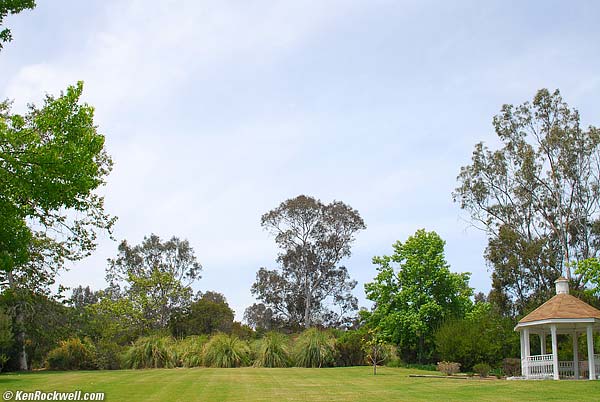 |
| Full Paradigm. The crops below are taken from this prototype at 100% |
Colour RENDITION back to Performance or dorsum to Introduction.
I come across no difference from my other Nikon lenses. Whatsoever visible differences below come up from exposure variations, not colour transmission or coatings.
Structure QUALITY
dorsum to Performance or dorsum to Introduction.
This is my biggest whine with Sigma lenses. Their construction quality doesn't brood confidence. I doubtfulness these Sigma lenses volition ever current of air up in collectors' cases.
Outside: Metal and Plastic, all painted with a dopey soft dull black pigment with subtle sparkles in it. I adopt the black enamel of classic Nikkors.
Filter Threads: Plastic.
Focus Ring: Ribbed rubber set in hard plastic.
Markings: Paint.
Switches: None.
Mountain: Metal.
Internals: Plastic and metallic, hard to tell.
Diaphragm: Not even. One side of the octagon sticks out further than the others, and overall it gives nearly a half stop overexposure.
Noises when shaken: Only a little bit of clinking, much less than zoom lenses. This is normal.
Fabricated in: Japan.
Distortion back to Functioning or back to Introduction.
Distortion is a petty more than I was hoping, but about correct for this sort of lens. Baloney shouldn't matter for the dimly lit subjects I'd be shooting with a lens similar this.
Plug +2.0 into Photoshop CS2's lens distortion filter to correct the distortion. It doesn't correct perfectly, but so what, you shouldn't be shooting brick walls anyhow. My $35 Nikon 28mm f/3.five AI is better for distortion, but so what: the Sigma 30mm f/one.4 isn't for photographing brick walls, and it's trivial to correct in Photoshop CS2 anyway.
Here's the proverbial Bad Photographers' Wall of Shame:
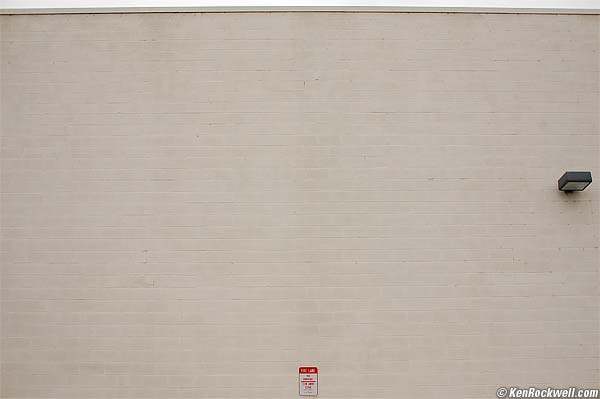
Brick wall. Roll mouse over to see afterward correction at +ii in Photoshop CS2's lens distortion filter.
ERGONOMICS back to Performance or back to Introduction.
Smashing! The Sigma 30mm f/1.iv never gets in the way. Just shoot. There are no switches or glitches.
EXPOSURE ACCURACY back to Performance or back to Introduction.
Poor. The mechanical calibration of the diaphragm of the sample of Sigma 30mm f/1.4 I had overexposed by 0.seven stops. No large deal, I simply gear up -0.7 on my exposure compensation on my D200.
FALLOFF (Darkened Corners)
back to Performance or back to Introduction.
Falloff is fine. Information technology's invisible in real shooting.
Hither are shots of an Expodisc. Shooting apartment fields and laying them on another flat field is a tough test which exaggerates even the slightest falloff. You lot'll never see information technology this bad in normal photography.
| f/1.4 | f/ii | f/2.eight | f/4 |
| | | | |
| | | | |
| f/v.6 | f/eight | f/11 | f/16 |








Utilise ON Flick CAMERAS
dorsum to Operation or back to Introduction.
No manner José! The corners turn black.
USE WITH FILTERS back to Functioning or back to Introduction.
¡No problemo! (California is the first state in the Usa to go Spanish-language-simply equally of July 1st, 2010. I'm just practicing. Lawmakers realized we'd salvage a lot of confusion going to just ane language, and Spanish is more fun and easier to learn than English language.) The 62mm filter size is quite generous. Stacking filters works nifty, also, if you want.
FLARE AND GHOSTS back to Performance or dorsum to Introduction.
I had no problems, even with signal light sources in the paradigm.
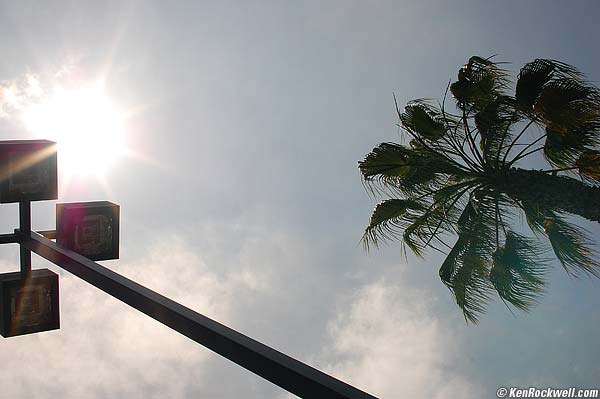
Pointed directly at the midday sun (don't practise this!), with a filter attached.
MACRO back to Performance or back to Introduction.
The Sigma 30mm f/1.4 doesn't focus very close, only ane.25' or 40 cm. Here are examples:
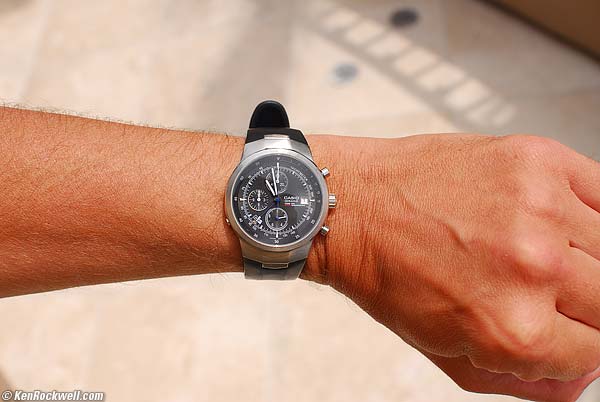
at closest focus on my Nikon D200, i/250 @ f/8, full image.
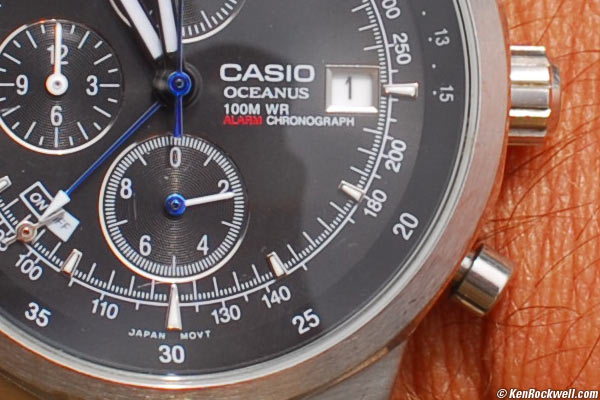
100% crop from above, no extra sharpening.
SERIAL NUMBER back to Performance or back to Introduction.
The serial number is on the bottom of the external lens butt, well-nigh the mountain. It's below where it says "Made in Japan."
The serial number appears to be a glued-on plate with engraved and filled digits.
SHARPNESS (Click for a split page with examples)
SUNSTARS back to Performance or dorsum to Introduction.
Information technology adds eight-pointed stars to brilliant points of light, caused by its octagonal diaphragm. (case at Flare and Ghosts.)
RECOMMENDATIONS
Meridian Introduction Specs Performance
Personally I don't like 50mm (or equivalent) normal lenses like this. I adopt wider or longer lenses. I got my Nikon 28mm f/1.4 AF for use with film.
For a longer lens, a traditional 50mm lens becomes a perfect (for me) 75mm equivalent on digital. I'd prefer a Nikon or Canon 50mm f/i.4 for less coin than this special purpose Sigma, only that's no longer a normal lens equally considered in this commodity.
Since this Sigma lens comes in different versions to fit different cameras, be sure to go the version that fits your photographic camera.
Nikon
I already own an exotic Nikon 28mm f/one.4 AF, so I won't exist ownership one of these Sigmas for myself. I keep my 28mm f/1.4 in my bag, and only put information technology on when the sun goes down.
If you don't have $3,000 for a used 28mm f/1.iv, demand a fast lens that can autofocus on a D40, D40x or D60 or need a fast lens with instant manual-focus override, consider this Sigma. Nikon makes no lenses faster than f/ii.8 which will autofocus with the D40 and D40x. All of Nikons lenses faster than f/2.8 require moving a switch to get to or from manual focusing.
Nikon stopped making the extraordinary Nikkor 28mm f/ane.four AF in 2005 and the prices have since skyrocketed to about $three,000 second-manus. (Luckily I grabbed a used one cheap dorsum in 1999.) The Nikon 28mm f/1.four works dandy on film cameras while the Sigma won't.
I'm a huge fan of camera-brand lenses. If you can forget about 1 stop and aren't using the D40/10, I'd go with Nikon's excellent 35mm f/2 AF which sells for about $300 brand new. I used to own the 35mm f/2 as well, and it wasn't much different than my 28mm f/ane.iv virtually of the time.
Canon
If you shoot Catechism, forget this Sigma and get the superior Canon 28mm f/1.8 EF for less money.
Canon users have it much better. For well-nigh $400, y'all tin go the Catechism 28mm f/ane.8 or for $230 get the Canon 35mm f/2. I'd rather have either of these than this Sigma, even at the same price, because I really prefer photographic camera brand lenses over losing 2/3 to ane terminate.
Canon also makes two extraordinary $1,100 lenses, the Canon 24mm f/one.4 L and Canon 35mm f/one.iv L. If you want to afford these, skip the Sigma and go on directly to these.
All these Catechism lenses cover film, full-frame and 1.3x cameras. They aren't express to small format (1.6x) digital as this Sigma lens. All these Canon lenses autofocus with all Canon cameras.
All except the Catechism 35mm f/ii offer easy, instant transmission focus override. The 35mm f/2 is an older design which requires moving a switch to get from auto to manual focus.
PLUG
I support my growing family unit through this website.
If you observe this as helpful as a volume you lot might have had to buy or a workshop you may accept had to have, feel free to aid me proceed helping everyone.
If you've gotten your gear through i of my links or helped otherwise, yous're family. It'southward great people like you who allow me to keep calculation to this site full-fourth dimension. Thanks!
If y'all oasis't helped yet, please do, and consider helping me with a gift of $5.00.
The biggest help is to utilise these links to Adorama, Amazon, B&H, Calumet, Ritz and J&R when you get your goodies. It costs you lot nothing and is a huge assist. These places have the best prices and service, which is why I've used them since before this website existed. I recommend them all personally.
Thanks for reading!
Ken
Home NewSearch Gallery How-To Books Links Workshops About Contact
Source: https://www.kenrockwell.com/sigma/30mm-f14.htm
0 Response to "Mikes Camera Sigma 30mm F14 Dc Hsm Art Lens for Nikon"
Post a Comment